HALO
The deep voice of ceramic, with an electronic tail shaped by the palm.
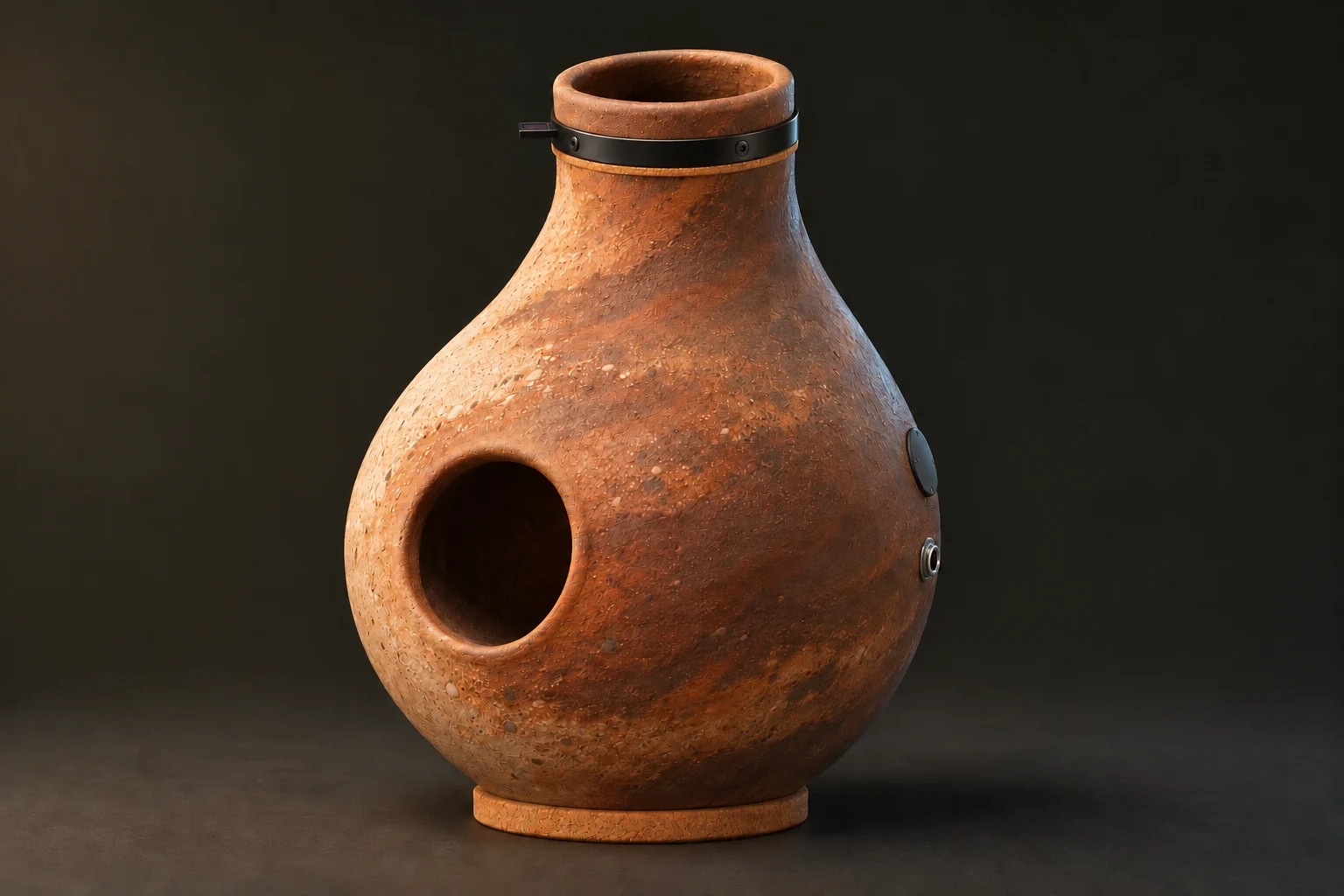
Studio visualization. Not to scale.
Where the sound begins.
A ceramic vessel with one internal cavity, a neck, and a side playing hole. Body strikes excite the walls; palm strikes at the opening excite the air inside. Partly covering the neck changes the resonance. A removable sensor ring mounts outside the vessel, leaving the playing openings clear.
A new degree of freedom.
A ToF rangefinder estimates the distance to the palm within a limited field of view. A contact sensor picks up the wall’s vibration, while an external microphone can separately record the hole’s air response. Distance controls a digital filter’s frequency. Its movement is linked to the gesture, but does not measure the internal air resonance.
How to play it.
Strikes and partial closure of the opening shape the acoustic sound; palm height controls the electronic tail.
- Sonic character
- Deep air pulses and narrow, whistling resonances.
- Materials
- Grog-tempered ceramic · cork · aluminum
Practical considerations.
Two holes in one cavity do not form two independent chambers. Partial closure changes the aperture geometry and losses, so the formula for a single Helmholtz resonator gives only a rough estimate. The rangefinder has an unreliable near-field measurement zone; if the palm leaves its field of view, the mapping smoothly returns to a neutral value.
Small batch.
Small batches of three vessels. Minor differences in ceramic geometry remain, so each sensor ring and audio chain is adjusted individually.
Contact the studio for the current configuration, instrument availability, and assembly schedule.
The story behind one design decision.
How can we preserve the feel of a hollow vessel when the gesture gains a digital extension?
HALO is built around one cavity with two openings. This allows wall strikes, air pulses, and gradual neck closure to be combined. The electronic voice follows hand height but need not copy the acoustic resonance: it can diverge from it and create beats.
What changed in the design
The sensor moved from the neck to an external ring to free the palm’s movement and make the electronics easier to access. The ring can be removed for servicing. Each of the three vessels in a batch is adjusted to its own acoustic response.
First study.
Three actions to hear the design at work and feel its limits.
Record a wall strike and an impulse at the hole in separate takes.
Slowly cover the neck while keeping the electronic filter fixed.
Enable the hand mapping and offset its range relative to the acoustic movement.
Care and recalibration
Place the vessel on a soft support that does not block the holes. Do not use the sensor ring as a carrying handle. Check the rangefinder’s working area under the lighting at the performance venue.
What the instrument record contains ↗