TESSERA
A wooden rhythm whose algorithm you can literally see.
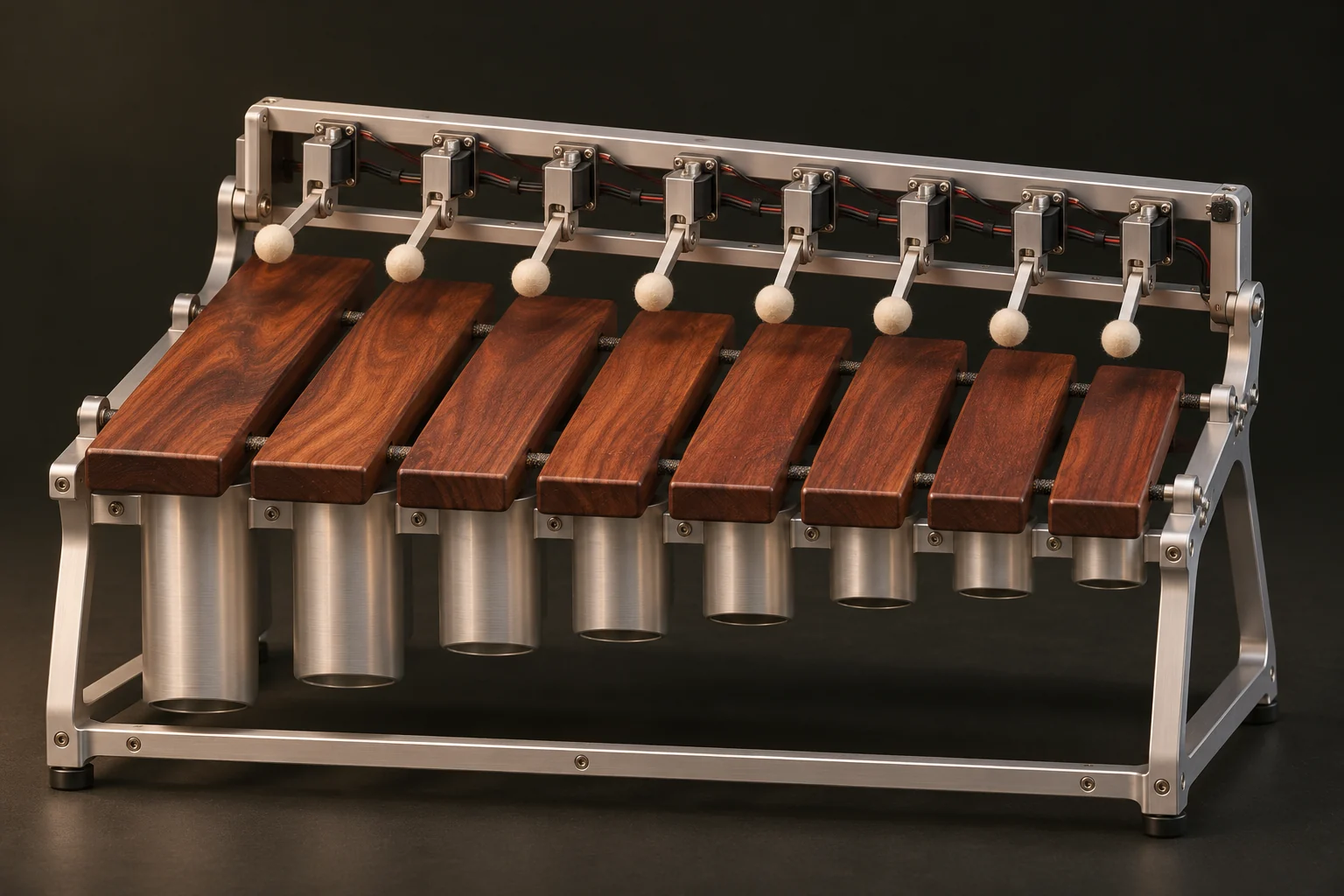
Studio visualization. Not to scale.
Where the sound begins.
Eight wooden bars with individual tubular resonators. The balafon principle of separately tuned wooden voices is paired with a hinged frame of electromechanical strikers.
A new degree of freedom.
Solenoids drive eight soft hammers through drivers that suppress coil voltage spikes. The controller limits pulse duration and duty cycle. After a strike, the hammer must have time to return and clear the bar; a new command arriving too soon is skipped.
How to play it.
An automated ostinato leaves room for hand-played responses. To switch to fully manual playing, the performer stops the mechanical layer and moves the striker frame aside; an interlock prevents pulses while the frame is raised.
- Sonic character
- Dry wooden attacks with slowly diverging rhythms.
- Materials
- Hardwood · felt · aluminum tubes
Practical considerations.
MIDI velocity is mapped through an individual strike-force curve, not a direct linear relationship. Heating depends in part on repetition density. Controller limits take precedence over incoming note density: an event queue must not become a delayed barrage.
Working prototype.
A working eight-voice workshop module. Current work focuses on balancing strike strength and making hammers quick to replace.
Contact the studio for the current configuration, instrument availability, and assembly schedule.
The story behind one design decision.
Can an automated rhythm leave room for a human response?
TESSERA’s hammers sit on an exposed hinged frame, making the mechanism’s movement part of the performance. The sequence of events becomes a visible, audible pattern of strikes. Scores usually give the mechanism a steady cycle, leaving pauses, accents, and rhythmic shifts to the performer.
What changed in the design
Working with eight bars required eight strike curves. The same command does not produce the same loudness on different assemblies. ORBIT SCORE therefore creates musical events, while the local controller decides which are mechanically permissible.
First study.
Three actions to hear the design at work and feel its limits.
Start a sparse cycle on two bars.
Add a hand-played response between strikes without increasing the density of automation.
Make the cycle more complex until the controller starts skipping events, then return to a musically clear density.
Care and recalibration
Stop the mechanism before raising the frame. Check that hammers return freely and that there is clearance above the bars. An overheat state ends the mechanical part rather than placing it in a waiting queue.
What the instrument record contains ↗