REGOLITH
Build new matter from the traces of the old.
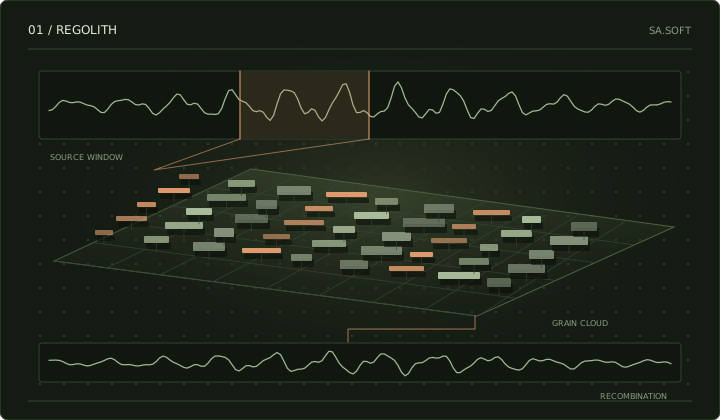
- Engine
- Granular playback
- Working environment
- Format: VST3 / AU
- Studio build
- A studio tool for preparing textures and performing. Configuration and project integration are discussed individually.
Musical objective.
Short recordings of friction, plucks, and breath become a controllable cloud. Playback position, density, and pitch spread are mapped to independent axes.
Capabilities.
- Load a short audio fragment
- Grain control through MPE gestures
- Fixed random seed for repeatability
Signal path.
Engineering trade-off.
Processing load increases with the number of simultaneously active grains. Short grains can be smaller than an audio buffer: the engine calculates them within the block. Their useful length depends on the material, window function, and desired timbre; buffer size separately affects control latency.
From studio practice.
Works with sound: receives audio material and control events.
REGOLITH’s first material was short contact recordings—dry, uneven, with a pronounced attack. The engine grew from a desire to preserve their roughness even when individual plucks could no longer be distinguished. GRAIN became its natural controller: a single physical pluck can open up an entire cloud, without having to sound the same every time.
How the method works
A grain is a short excerpt of a recording with a shaped envelope. Density sets the number of new grains per second; together with duration, it determines their overlap. Playback position selects the source region. Pitch is changed by varying playback speed within each grain, which can also alter its timbre. As density increases, check the summed level and available headroom.
One working approach.
Record one GRAIN pluck or a short acoustic gesture on AER, and retain the original file.
Select an attack region and a decay region; compare them at the same density.
Map GRAIN’s relative pluck intensity to the initial grain density. Use a separate MIDI control for playback position. Check that the event-end command stops new grains while those already active finish their decay.
What is saved with the project
The material reference, its checksum, region boundaries, controller map, and generator seed are saved. Repeatable events require the same engine version and input messages; a live performance does not become an identical file.