SEREIN
Gravity writes the score, and the performer changes its tilt.
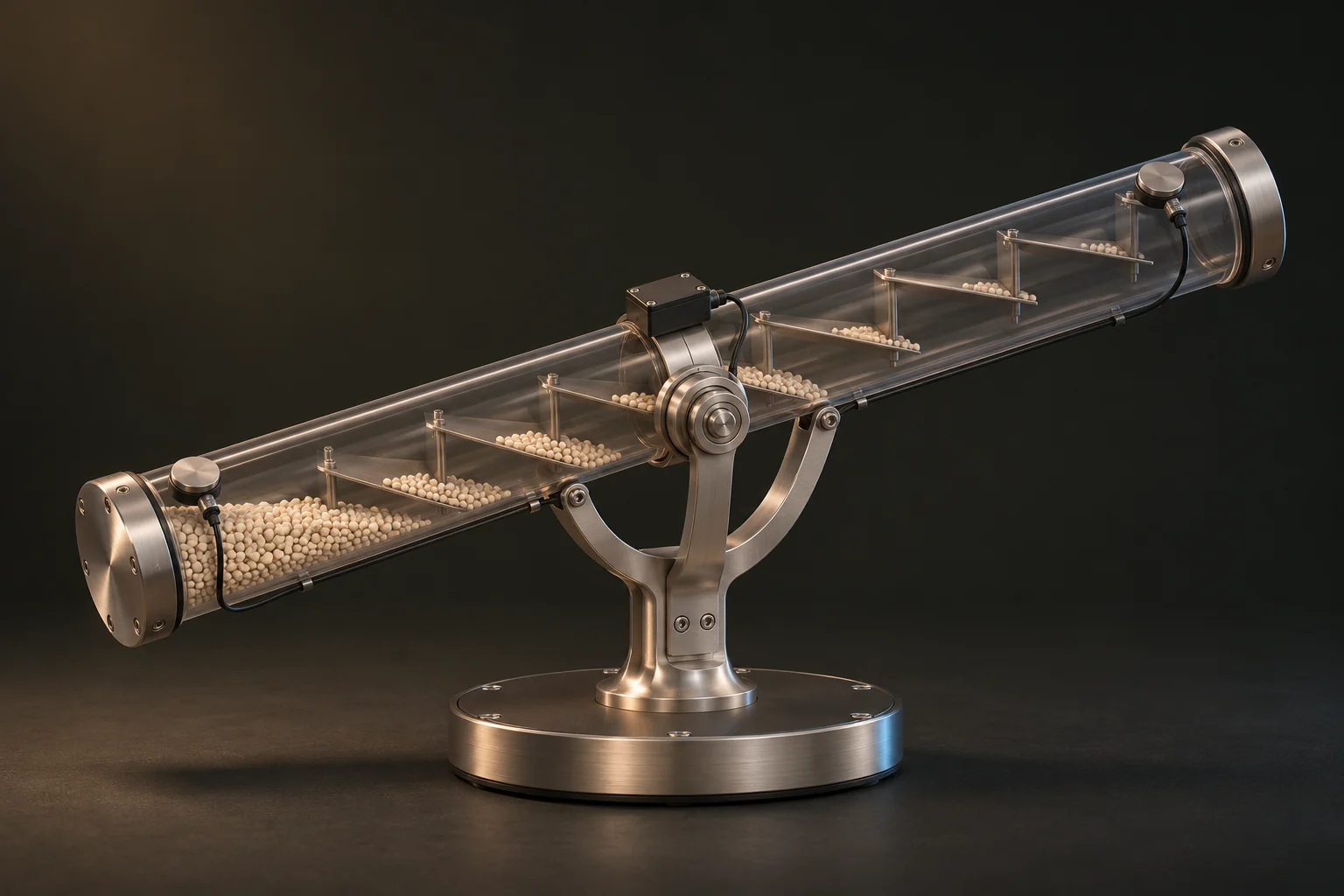
Studio visualization. Not to scale.
Where the sound begins.
A transparent tube with internal baffles and ceramic granules on a manually rotated suspension. The rainstick principle is made visible and equipped with sensor readout.
A new degree of freedom.
The inertial module combines gyroscope and accelerometer readings to estimate the tube’s orientation. Two contact pickups record different parts of the flow. Through SOMATIC, tilt controls the density of REGOLITH’s granular layer; the electronics neither count individual granules nor replace their acoustic sound.
How to play it.
The performer slowly passes the angle at which the granules begin to slide, then returns the tube. Individual collisions and small avalanches emerge. Rotation speed affects the result alongside slope, friction, and where the granules were before the movement.
- Sonic character
- Dry rain, microrhythms, and occasional rolling cascades.
- Materials
- Polycarbonate · ceramic · stainless steel
Practical considerations.
The flow depends on the previous position and can temporarily jam at the baffles. Tilt does not translate into an exact number of impacts per second. Under sudden acceleration, the orientation estimate becomes less reliable; the controller limits jumps in the control parameter.
Small batch.
Assembled four at a time. The granules, baffles, and suspension are selected together; each instrument retains a slightly different character.
Contact the studio for the current configuration, instrument availability, and assembly schedule.
The story behind one design decision.
How do you play a rhythm that depends on a material’s memory?
In SEREIN, each movement starts with the distribution of granules left by the previous one. This dependence on what came before gives the instrument its “memory.” Through the transparent tube, the performer can see where granules gather and anticipate the next flow.
What changed in the design
The control mapping uses the angle, direction, and speed of rotation. Fast changes are smoothed to prevent abrupt jumps in the electronic parameter. The performer turns the tube by hand; sensors read the movement and pass it to the software.
First study.
Three actions to hear the design at work and feel its limits.
Wait for the granules to settle, then tilt the tube until the first movement.
Hold the position and listen as the flow thins without any further hand movement.
Return the tube and begin a second phrase without trying to repeat the first exactly.
Care and recalibration
Record the filler’s mass and composition in the instrument record. Changing the quantity of granules requires recalibration. Before playing, check that the suspension moves freely and the sensor cables are not under tension.
What the instrument record contains ↗