NACRE
A plucked note that gradually becomes a motionless, luminous cloud.
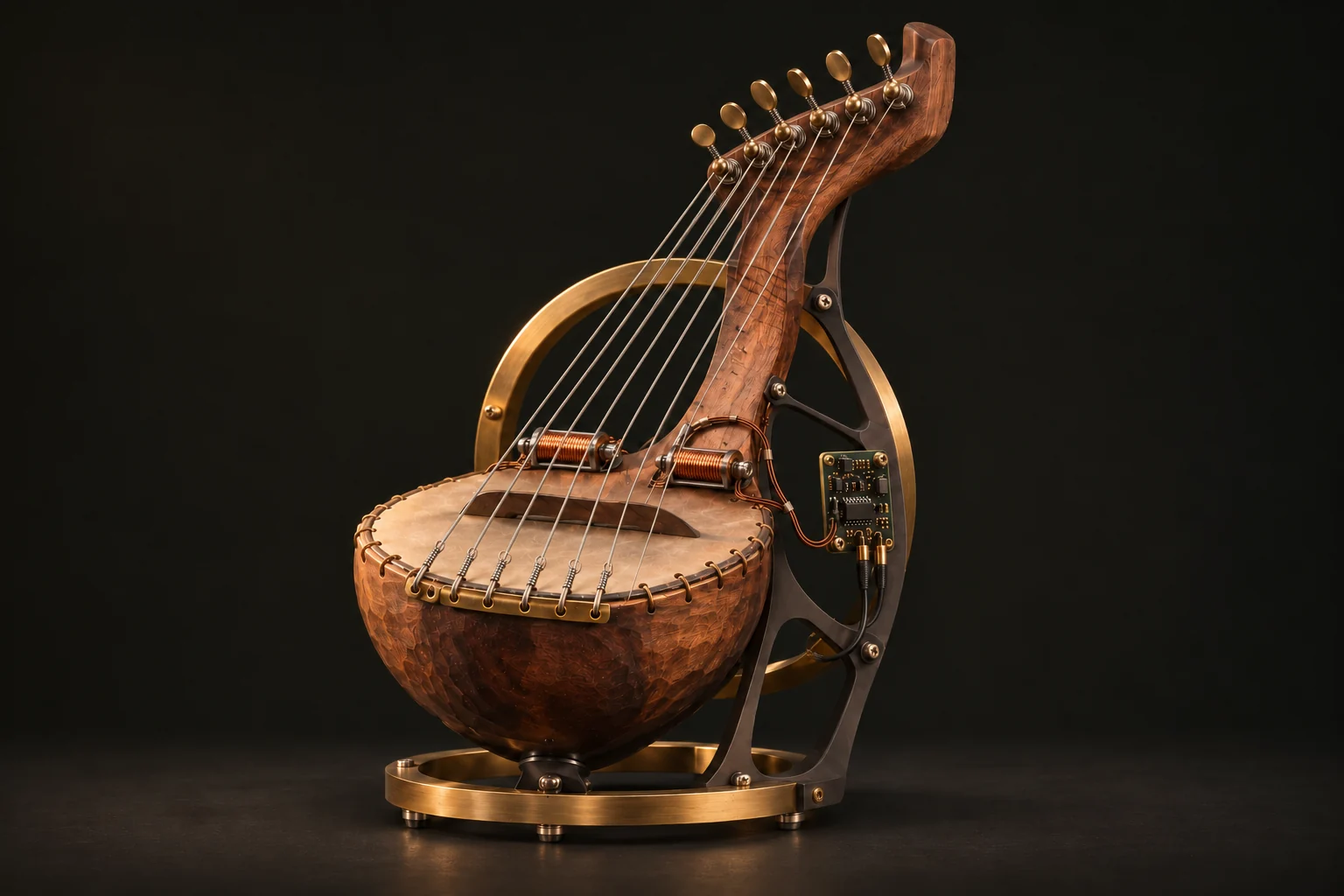
Studio visualization. Not to scale.
Where the sound begins.
Six open steel strings pass over a bowl-shaped walnut body with a thin, tensioned skin soundboard. The kora inspired the combination of a resonator and playing with thumbs and index fingers; NACRE’s tuning, single-row string layout, and short supporting neck are its own. A brass ring supports the body rather than setting the notes’ pitches.
A new degree of freedom.
Two magnetic exciters with permanent magnetic bias work on groups of strings. A contact sensor on the bridge feeds a separate low-latency loop: band-pass filters, phase correction, gain limiting, and coil drivers. Energy is returned to the strings; the body still radiates the sound. Recording and external effects connect through a separate branch.
How to play it.
Thumbs and index fingers shape a short pattern; a pedal gradually turns individual notes into sustained resonance.
- Sonic character
- Warm attack, metallic overtones, and slowly growing sustain.
- Materials
- Walnut · skin soundboard · steel strings · brass · aluminum
Practical considerations.
Sustaining vibration requires a suitable string alloy, a small air gap, and the correct loop phase. Retune the filters when changing the tuning. Two excitation channels do not provide six independently controlled voices. When strings are damped by hand, a threshold detector reduces the energy supply; current and temperature limits are no substitute for correct mechanical setup.
Small batch.
We build batches of four instruments. Body, strings, and excitation loop are tuned as one acoustic system.
Contact the studio for the current configuration, instrument availability, and assembly schedule.
The story behind one design decision.
How can we preserve a recognizable pluck while letting the performer decide when it ends?
NACRE grew out of recordings of open strings: the long digital tail was beautiful, but it did not respond to the hand as the string itself did. So we moved the source of sustain back into the instrument. The short neck and compact body keep both plucking and damping within a single hand position.
What changed in the design
We replaced the early shared broadband feedback circuit with two tunable channels. This reduced competition between resonances while preserving acoustic interaction between strings. Permanent magnetic bias and phase adjustment are part of the exciter design; increasing gain alone does not solve the problem.
First study.
Three actions to hear the design at work and feel its limits.
Play sparse plucks with excitation off and memorize the natural decay.
Use the pedal to bring the feedback to a stable sustain, leaving only one group of strings undamped.
Damp the strings one by one, then release the pedal: the hand should own the end of the phrase.
Care and recalibration
After changing strings, check the gap above the exciters, the filter tuning, and the damping threshold. The tensioned soundboard responds to humidity; adjust its tension separately from tuning the strings.
What the instrument record contains ↗